Detroit Museum of Art Clay Tablet Sumerian Culture Iraq
The art of Uruk encompasses the sculptures, seals, pottery, architecture, and other arts produced in Uruk, an ancient metropolis in southern Mesopotamia that thrived during the Uruk menstruation effectually 4200-3000 BCE.[ane] : 40 The city connected to develop into the Early on Dynastic Flow (Mesopotamia) around 2900-2350 BCE.[2] Considered one of the first cities, the site of Uruk – modern-solar day Warka in Iraq – shows evidence of social stratification, institutionalized religion, a centralized administration, and what art historians would categorize every bit high art and architecture,[1] : 41 the start in the long history of the art of Mesopotamia. Much of the art of Uruk shows a high technical skill and was oft made using precious materials.[1] : 46
Sculpture [edit]

Fragment of a Bull Figurine from Uruk, c. 3000 BCE
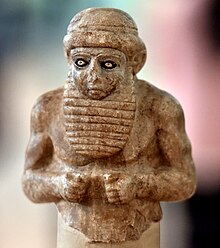
Votive sculptures in the form of small fauna figurines accept been found at Uruk, using a style mixing naturalistic and abstract elements in guild to capture the spiritual essence of the animate being, rather than depicting an entirely anatomically authentic effigy.[i] : 50 The utilize of animal figures as votive offerings as opposed to human being figures probably replaces a ritual act of animal sacrifice and makes it eternal by leaving the image of the sacrificed creature in the temple.[1] : 51 Many of these creature votives were discovered at Uruk Level Iii (c. 3000 BCE) and would take been offered to the goddess Inanna in render for her favor.[5] : sixteen
A group of objects dubbed Kleinfunde or "small-scale finds" by excavators was likewise discovered in Uruk. The collection of small objects consisted of animate being figures inlaid with stone, and vessels that would have been used for rituals in the temple merely had since gone out of utilize and were subsequently cached in sacred ground rather than discarded unceremoniously.[1] : 51 Similar fauna figures could take been used as amulets or cylinder seal handles.[5] : 17
Narrative art [edit]
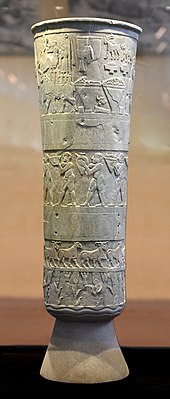
Uruk is too the discover place of ii of the oldest examples of narrative fine art, the Uruk Trough and the Warka Vase. Though information technology could not take functioned every bit a basin, the limestone Uruk Trough could accept functioned as a cult paradigm in the temple of Inanna and shows flocks of sheep carved in relief approaching a reed hut with lambs coming out of the structure.[six] According to the British Museum where this object is held, the scene with sheep could represent the fertility of the flock while it is under Inanna'south protection,[6] although the "animals emerging from a hut" motif could likewise exist associated with agronomical do where shepherds would separate ewes and lambs during the day to help conserve the ewe's milk.[7]
The Uruk or Warka Vase depicts a religious banquet, probably associated with an agronomical festival,[8] that is connected to rituals involving the goddess Inanna.[1] : 46 The vase is divided into iv registers: the bottom annals depicts water, plants, and ears of wheat; the second depicts right-facing sheep; the 3rd depicts left-facing nude priests with offering vessels; and the fourth and top register depicts a "priest-king" (damaged) and attendant moving right to arroyo Inanna herself,[8] who can be identified by the 2 reed gateposts leading into her temple filled with offerings behind her.[1] : 48 This order of registers from bottom to top could reverberate the social bureaucracy and loosely represent the ranked administration that has been identified in the urban center of Uruk.[9] : 156–157
Mask of Warka [edit]
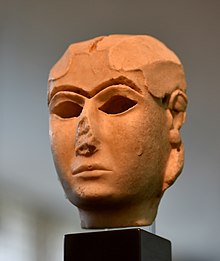
In addition to narrative art, one of the nearly famous examples of sculpture found at Uruk is the marble head of a goddess, the Mask of Warka or Lady of Warka, which most likely represents Inanna.[x] It was discovered in the Eanna commune at Uruk.[eleven] Dating to circa 3100 BCE, information technology is probably from one of the primeval known almost life-size sculptures.[12] The face of the sculpture was nigh likely inlaid with precious stones such equally lapis lazuli. The head one time belonged to a larger blended statue of the goddess, which was most likely made out of wood.[1] : 48
Equally with the votive beast figurines, the style has abstruse elements such as the eyebrows which would accept been inlaid with stone, as well as naturalistic elements, such as the soft, rounded cheeks and lips.[1] : 49
Seals [edit]
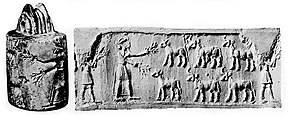
The king-priest and his acolyte feeding the sacred herd. Uruk catamenia, ca. 3200 BCE.

Cylinder-seal of the Uruk menses and its impression, c.3100 BCE. Louvre Museum
Beginning in the Heart Uruk menstruum, traditional stamp seals were replaced past cylinder seals.[13] : 212 Uruk was the first civilization to make utilise of cylinder seals, a practice that would eventually permeate the entirety of the aboriginal About East, as well as Statuary Age Greece.[one] : 54 Cylinder seals were used by individuals and were a mark of 1's identity as they acted as a signature and were used for officiating documents.[i] : 54 The small objects were cylindrical in shape and were engraved with metallic tools.[14] The carving was done in such a way that the seals could be rolled onto clay in order to make an impression.[15] Broken clay seal impressions have been plant amongst the same layers of debris on Eanna Level IV where early on clay writing tablets accept been constitute.[5] : 14 Though many of the recovered cylinder seals used to make such impressions are fabricated of rock, there is also evidence that the people of Uruk used metal over bitumen, trounce, and dirt to create cylinder seals.[13] : 209 The use of stone seals as signatures implies the existence of a complex administrative system in ancient Uruk.[1] : 54 The subject field matter depicted on the seal varied from kings and livestock to more religious subjects such as symbols of the gods.[16]
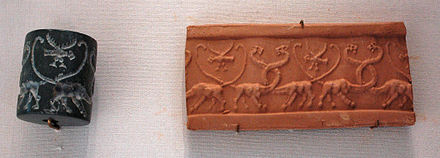
Cylinder seal and seal impression with serpopards and eagles from the Uruk menstruum (4100-3000 BCE)
Pottery [edit]

Beveled-rim bowl, c. 3400-3200 BCE
Pottery plant at Uruk includes wheel fabricated, mitt-fabricated and molded pieces. Potters at Uruk specialized in mass-produced functional vessels. The fast potter'due south cycle was introduced during the later role of the Uruk period, making it quicker and easier to produce pottery on a massive scale and with a greater sense of standardization.[xiii] Thousands of askew rim bowls take been found at the site, and it has been theorized that they were used to measure rations for families or dependant laborers.[17] : 5 Another innovation in pottery invented and used by the potters of Uruk is the ceramic ring scraper. As the exportation of ceramics began, the weight of a big vessel became problematic when travelling equally a trader. The ring scraper allowed excess, unnecessary material to be scraped from a vessel before firing, making the piece much lighter and easier to deport through boondocks or across the desert.[18] Considering of the power for artists to create pottery on a mass scale, the pottery of Uruk could be distributed to other parts of what is now modern Iraq. Studies have shown that Uruk pottery seemed to be more popular in northern Iraq than it was in southern Republic of iraq.[19]
Writing [edit]

Early writing tablet, c. 3100-3000 BCE
Archaeologists have found what are considered to exist the oldest written texts at Uruk.[1] : 56 From the start of excavation at Uruk in the early on 1900s, archaeologists institute clay tablets with pictographic signs that were recognized every bit precursors to cuneiform script.[v] : 11 This "proto-cuneiform" was drawn into the clay using a pointed tool and additional circular impressions symbolized numbers.[twenty] Dated to around 3200 BCE, these earliest tablets were establish among discarded materials in pits on Eanna Level IV and would most likely have been used to seal containers and doors.[5] : thirteen Approximately 4000 dirt tablets and fragments from this level have been found.[21]
Most of these tablets would accept recorded economic transactions and administrative texts such as exchanges of goods and the allotment of rations for workers,[i] : 56 [ii] and some record the number of livestock born into a given herd, every bit well every bit the amount of livestock, such every bit sheep and rams, that would have been allocated to individual owners.[22] 1 written text provides show of the social stratification of the city, list 120 officials including the city leader besides as those who led the law, the plow, and the lambs. This same text also provides special terms for priests, metalsmiths, and potters.[23] Past the third millennium BCE, other genres of writing, including verse, mathematics, and sciences, began to appear.[1] : 56
Architecture [edit]

Location of primary ruins within metropolis of Uruk
The largest remaining ruins at Uruk are the temple structures about the center of the urban center. The ruins, which consist of an approximately 6 foursquare kilometer expanse, are encircled past a city wall.[24] Uruk temple compages followed the building plans of the previous Ubaid civilisation. Structures were fabricated on tripartite plans with a central hall and smaller rooms on either side.[25] : 425 One of the near famous examples of Uruk temples is the White Temple, named after the white gypsum plaster that covered it. The White Temple, dedicated to the god Anu was built upon a platform 13 meters high. This manner is a predecessor to the ziggurat formations that would come later in Mesopotamian history.[26] Unlike later temples, the White Temple lacks a fundamental niche.[5] : 14
There is testify for buildings in Uruk used for cult purposes which were richly decorated and that contained altars for worship to the various gods.[27] For case, within Temple C in the Eanna District, pillars containing cone mosaic panels were discovered by excavators.[24] : 127 To create these panels, dated to around 3300-3000 BCE, 10-centimeter cones of broiled clay or gypsum were arranged and pressed into wet plaster and painted to create diamond, triangle, and zigzag patterns.[5] : nineteen
-

Reconstruction of a cone mosaic from the Eanna temple.
-

Particular of Reconstruction of a cone mosaic from the Eanna temple.
-

Male person deity pouring a life-giving water from a vessel. Facade of Inanna Temple at Uruk, Iraq. 15th century BC. The Pergamon Museum
-

Female person deity pouring a life-giving water from a vessel. Facade of Inanna Temple at Uruk, Iraq. 15th century BC. The Pergamon Museum
References [edit]
- ^ a b c d due east f g h i j k l m n o p Bahrani, Zainab (2017). Mesopotamia: Ancient Art and Architecture. London: Thames & Hudson. pp. 38–61.
- ^ a b Department of Aboriginal Near Eastern Art. "Uruk: The First Urban center". Heilbrunn Timeline of Art History. The Metropolitan Museum of Fine art. Retrieved 22 November 2017.
- ^ Art of the outset cities : the third millennium B.C. from the Mediterranean to the Indus. p. 25.
- ^ The Looting Of The Iraq Museum Baghdad The Lost Legacy Of Ancient Mesopotamia. 2005. p. viii.
- ^ a b c d e f g Nissen, Hans J. (2003). Aruz, Joan; Wallenfels, Ronald (eds.). Art of the First Cities: The 3rd Millennium B.C. from the Mediterranean to the Indus. New York: The Metropolitan Museum of Art. pp. eleven–20.
- ^ a b The British Museum. "The Uruk Trough". British Museum Collection Online . Retrieved 22 Nov 2017.
- ^ Delougaz, P. P. (1968). "Animals Emerging from a Hut". Journal of Well-nigh Eastern Studies. 27 (3): 193. doi:10.1086/371963. JSTOR 543534.
- ^ a b Collon, Dominique; Gaballa, One thousand.A.; Hedreen, Guy; Simpson, Marianna S.; Consume, D.A.; Jones, David Yard.; Leveto, Paula D.; Becker, Randy R. "Narrative fine art". Grove Art Online. Oxford Fine art Online by Oxford University Press.
- ^ Nissen, Hans J. (2001). Rothman, Mitchell S. (ed.). Uruk Mesopotamia & Its Neighbors: Cross-Cultural Interactions in the Era of Land Formations. Santa Iron: School of American Enquiry Press. pp. 149–180.
- ^ Marcovich, Miroslav (1996). "From Ishtar to Aphrodite". Journal of Aesthetic Education. 30 (2): 43–59. doi:10.2307/3333191. JSTOR 3333191.
- ^ Strommenger, Eva (1980). "The Chronological Sectionalization of the Archaic Levels of Uruk-Eanna Six to III/II: Past and Present". American Journal of Archæology. 84 (4): 479–487. doi:10.2307/504076. JSTOR 504076.
- ^ Hägele, Hannelore (eleven September 2013). Colour in Sculpture: A Survey from Ancient Mesopotamia to the Nowadays. Cambridge Scholars Publishing. p. 10. ISBN978-one-4438-5265-four.
- ^ a b c Pollack, Susan (2017). Burmeister, Stefan; Bernbeck, Reinhard (eds.). The Interplay of People and Technologies: Archaeological Case Studies on Innovation: Berlin Studies of the Ancient World, Vol. 43 (PDF). Berlin: Edition Topoi. pp. 205–224. Retrieved 22 November 2017.
- ^ Peck, William (1963). "Mesopotamian Cylinder Seals". Bulletin of the Detroit Institute of Arts. 42 (4): 73–75. doi:10.1086/DIA41504337. JSTOR 41504337.
- ^ Collon, Dominique (2006). Offset Impressions: Cylinder Seals in the Ancient Near East. London: British Museum Press.
- ^ Lawler, Andrew (2013). "The Everlasting City". Archæology. 66 (five): 26–32. JSTOR 24363682.
- ^ Kaercher, Kyra (2009). "A Comparison of Ceramics from Uruk and Susa circa 3000 B.C." (PDF). UW-50 Journal of Undergraduate Enquiry XII: 1–8.
- ^ Alden, J.R. (1988). "Ceramic Ring Scrapers: An Uruk Menses Pottery Production Tool". Paléorient. 14 (ane): 143–150. doi:x.3406/paleo.1988.4448.
- ^ Al-Soof, Behnam Abu (1968). "Distribution of Uruk, Jamdat Nasr and Ninevite V Pottery as Revealed by Field Survey Work in Iraq". Iraq. thirty (ane): 74–86. doi:x.2307/4199840. JSTOR 4199840.
- ^ The Metropolitan Museum of Art (2003). "Cuneiform tablet: authoritative account of barley distribution with cylinder seal impression of a male figure, hunting dogs, and boars". Heilbrunn Timeline of Art History. The Metropolitan Museum of Art. Retrieved 22 November 2017.
- ^ Oates, Joan. "Uruk". Grove Art Online. Oxford Art Online by Oxford University Printing.
- ^ Zawadzki, Stefan (2003). "Bookkeeping Practices at the Eanna Temple in Uruk in the Lite of the Text NBC 4897". Journal of Cuneiform Studies. 5: 99–123. doi:ten.2307/3515957. JSTOR 3515957.
- ^ Spar, Ira. "The Origins of Writing". Hielbrunn Timeline of Art History. The Metropolitan Museum of Art. Retrieved 22 November 2017.
- ^ a b Lenzen, Heinrich J. (1964). "New Discoveries at WARKA in Southern Iraq". Archaeology. 17 (2): 122–131. JSTOR 41670396.
- ^ Roaf, Michael (1996). Sasson, Jack M. (ed.). Civilizations of the Ancient Virtually E (PDF). New York: Scribner'due south. pp. 423–441. Archived from the original (PDF) on 2018-05-17. Retrieved 2017-xi-26 .
- ^ Museum of the Ancient Near Due east, Berlin. "Urban Life". Uruk: 5000 Year Megacity. Museum of the Ancient Almost East, Berlin.
- ^ Szarzyńska, Krystyna (1993). "Offerings for the Goddess Inana in Archaic Uruk". Revue d'Assyriologie et d'archéologie orientale. 87 (1): 7–28. JSTOR 23281582.
hardwickprehopecon.blogspot.com
Source: https://en.wikipedia.org/wiki/Art_of_Uruk
0 Response to "Detroit Museum of Art Clay Tablet Sumerian Culture Iraq"
Postar um comentário