Ralph Mcquarrie Original Star Wars Concept Art in Motion
 | |
| |
| Comments count:0

As Star Wars Rebels nears its end, the show returns to some of the key images of the first flavor: the wide-open plains and futuristic cities of Lothal, the planet that has always acted as the series' center of gravity. Lothal has been primal to the show from the showtime. The Ghost coiffure returns to Ezra Bridger's homeworld fourth dimension and once again, even as the Empire strengthens its foothold on the once-peaceful planet.
In fact, the planet owes much of its look to Ralph McQuarrie's concept art for the Star Wars Original Trilogy, which has carried through the entire saga as a visual language later artists such as Doug Chiang have connected to follow. Rebels references specific McQuarrie designs throughout its four-season run and follows that initial visual language when creating new characters.
Executive producer Dave Filoni referred to the show equally "Tower Story" in early development because of the central image of Lothal's communication towers. The cities of Lothal are 1 of the most clearly McQuarrie-inspired elements of the show, demonstrating the warmth of the light in McQuarrie's landscapes, mechanical work, and the slight grainy texture of the paint.
Concept art for the city of Aldera and the countryside of Alderaan were recycled into Lothal's Capital City and the rock towers outside the city.
You can see the clear inspiration for Uppercase City below:
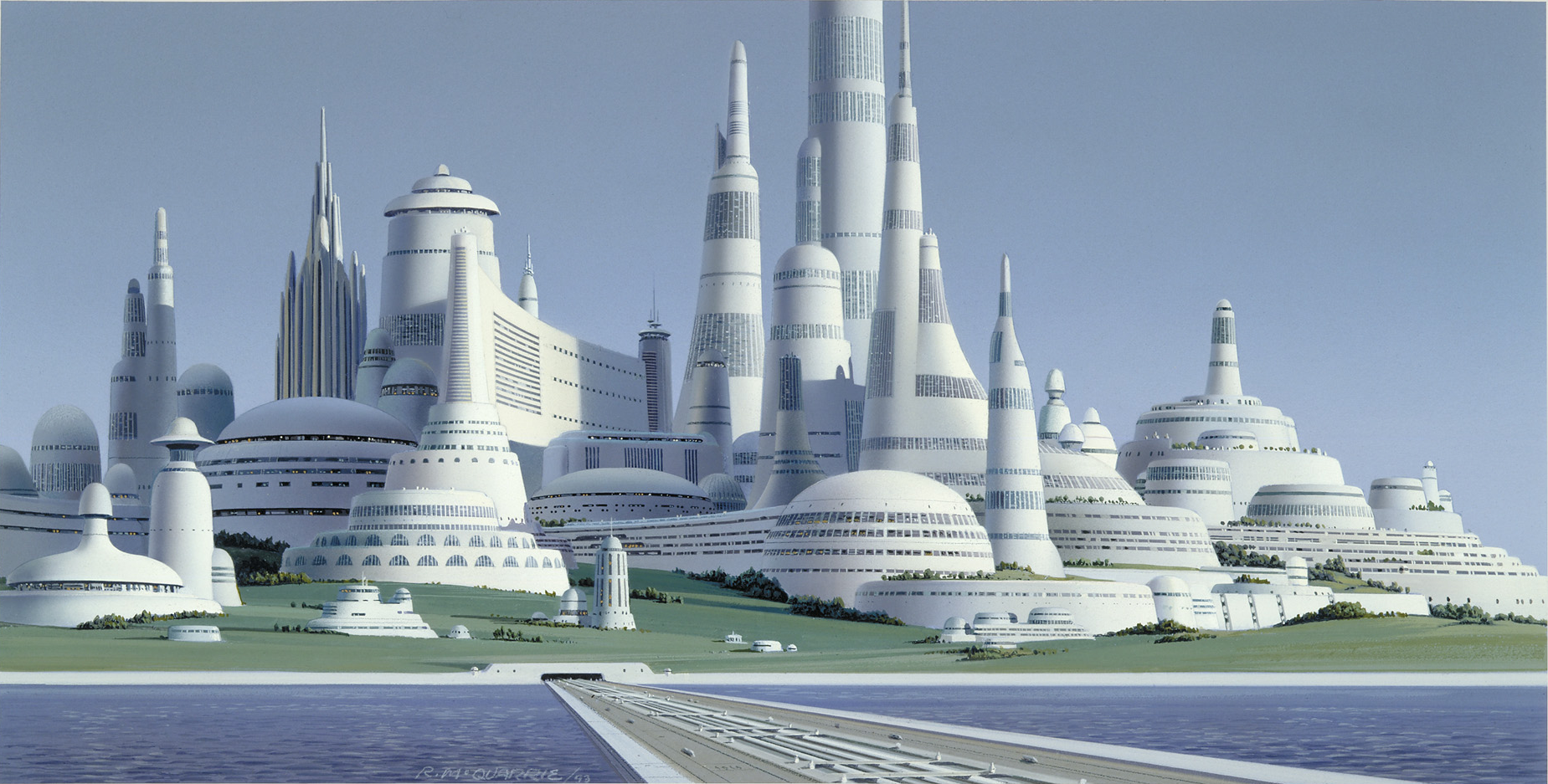
Ralph McQuarrie
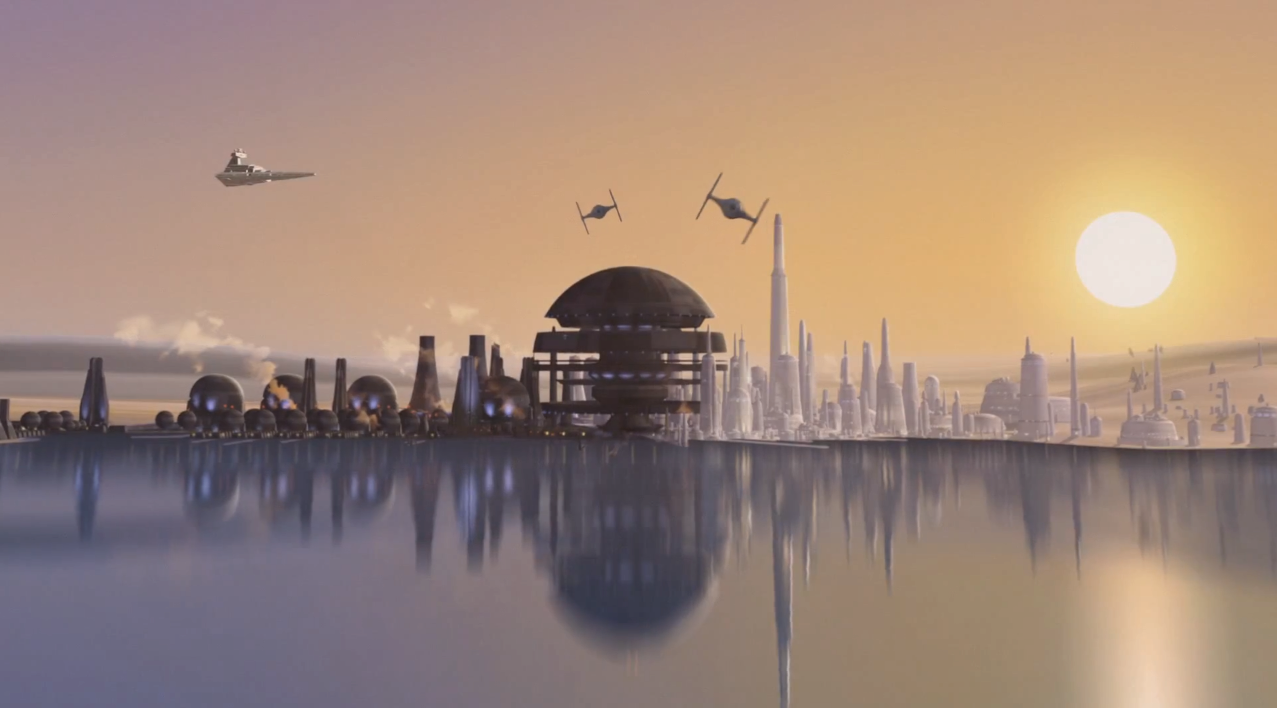
Lothal'south Capital letter City
Filoni told StarWars.com in 2015, "Nosotros wanted something that was going to be reminiscent of the Original Trilogy, so I suggested we base it on Ralph's designs. I wanted to do that on Clone Wars , just honestly, we didn't have the know-how to attain information technology at the fourth dimension. We were able to do it with Rebels though, with round-shaped characters and things that were a bit more classic animation." Filoni also recycled McQuarrie fine art in The Clone Wars , every bit when Hoth concepts became the snowy planet of Orto Plutonia.
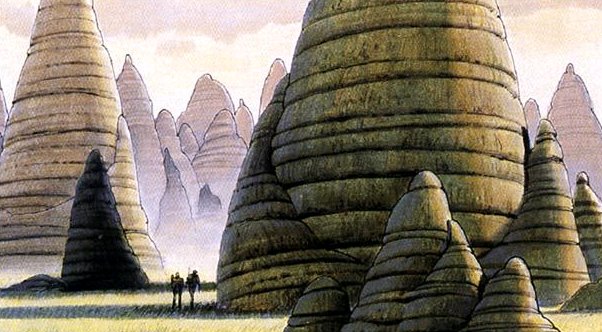
McQuarrie
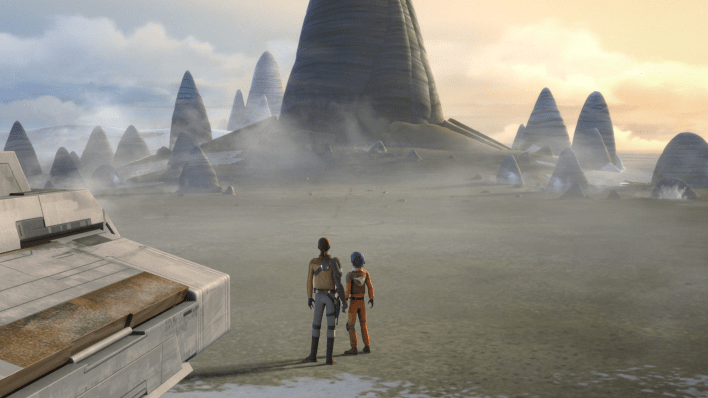
Jedi Temple on Lothal
That roundedness Filoni mentioned is one of the design choices that differentiates Rebels character designs from the more angular faces in The Clone Wars . Characters who appeared in both shows, such every bit Ahsoka Tano and Obi-Wan Kenobi, take rounder faces in Rebels , more moving picture grain, and less detailed costumes than in the latter seasons of The Clone Wars . At best, the painterly effect makes Rebels unique; at worst, faces and mechanical structures become gelatinous and muddy.
In order to brand each frame of the show await like a painting and for the unabridged show to accept a distinct visual mode, the artists needed to evidence a hint of the brushstrokes that might have gone into a painting. That's why the Rebels art squad uses digital brushes that replicate the look of manus-drawn lines and hand-painted art. This gives a grainy wait to the scenes that solidifies them and makes the prove expect more cinematic.
Forth with the painterly haze, McQuarrie's art too displays a distinct apply of infinite. Wide landscapes coexist easily with more intimate, even claustrophobic settings. A key instance is the view from the Expiry Star as the Millennium Falcon approaches, a scene which was replicated almost exactly on film as it had been in the concept fine art. The foreground characters give scale to the titanic machinery in the background, This is also evident in the design language of the Sith temple on Malachor, where characters walk through narrow hallways with the huge temple looming in the groundwork.
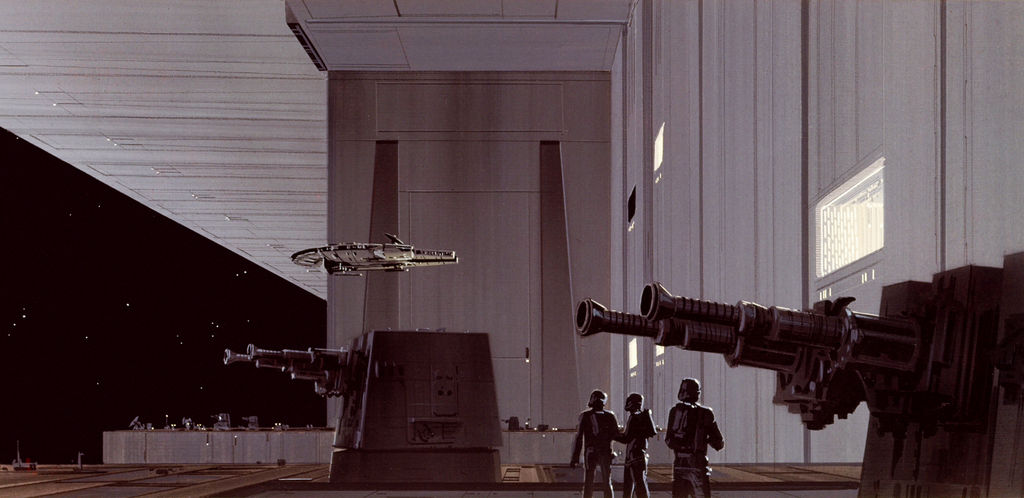
McQuarrie
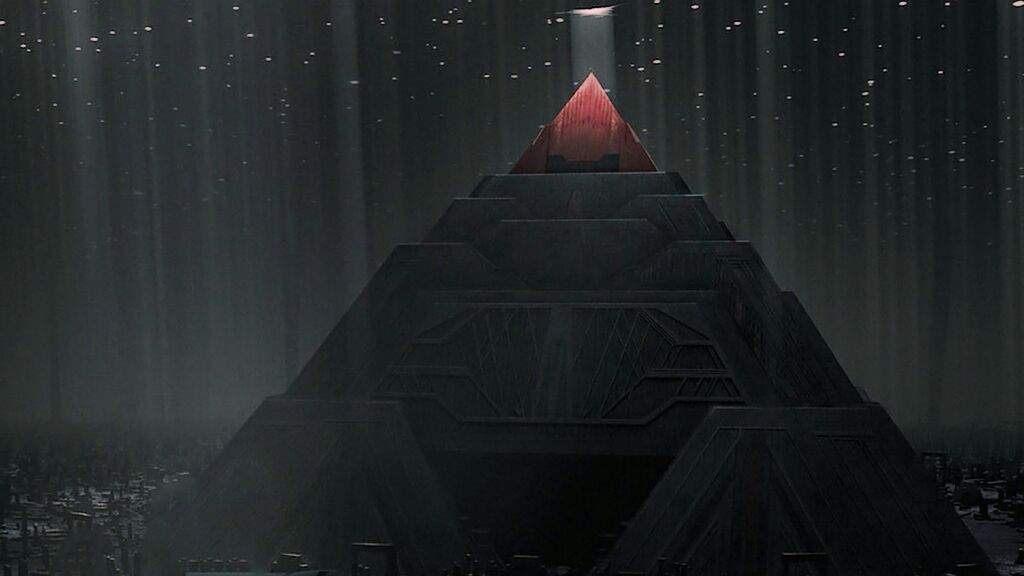
Sith Temple on Malachor
The lightsabers also look particularly unique to Rebels and McQuarrie. Consider the thin, almost translucent blades in this analogy, which was also used for the cover of the A New Hope novelization. Filoni and VFX atomic number 82 Joel Aron intentionally made the lightsabers in Rebels await more like those in A New Hope , based on McQuarrie's designs. Like the weapons in the concept fine art, the lightsabers in Rebels taper to narrow points at the end.
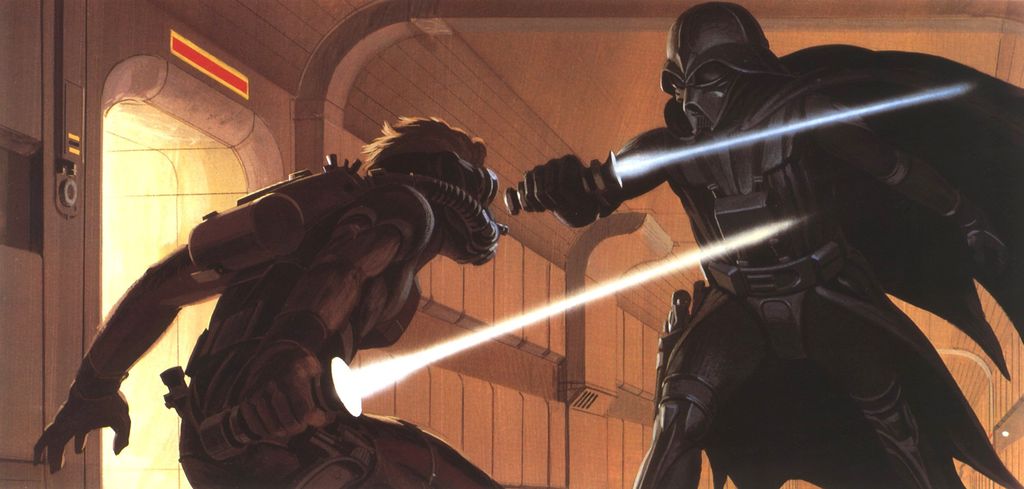
McQuarrie
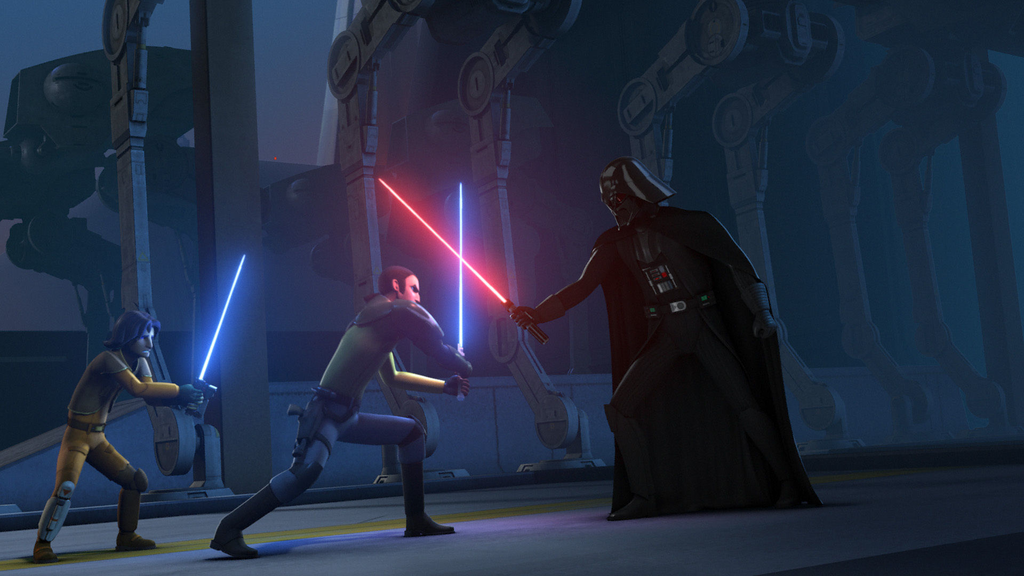
Ezra and Kanan duel Darth Vader
The alien Zeb was based on one of McQuarrie'south designs for Chewbacca. Unlike the Wookiee model that would somewhen become a famous part of the Star Wars saga, the early on concept had ears, a more prominent beard, and wears clothes. While the bandoleer stayed with Chewbacca, the outfit is more like to the one Zeb uses. The large blaster in the concept art became Zeb'southward bo-rifle. Early Yoda concept art likewise shares the same catlike ears as Zeb.
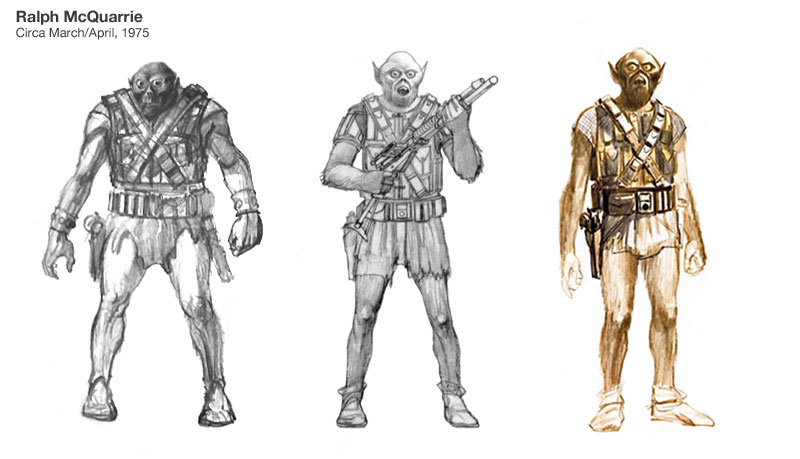
McQuarrie
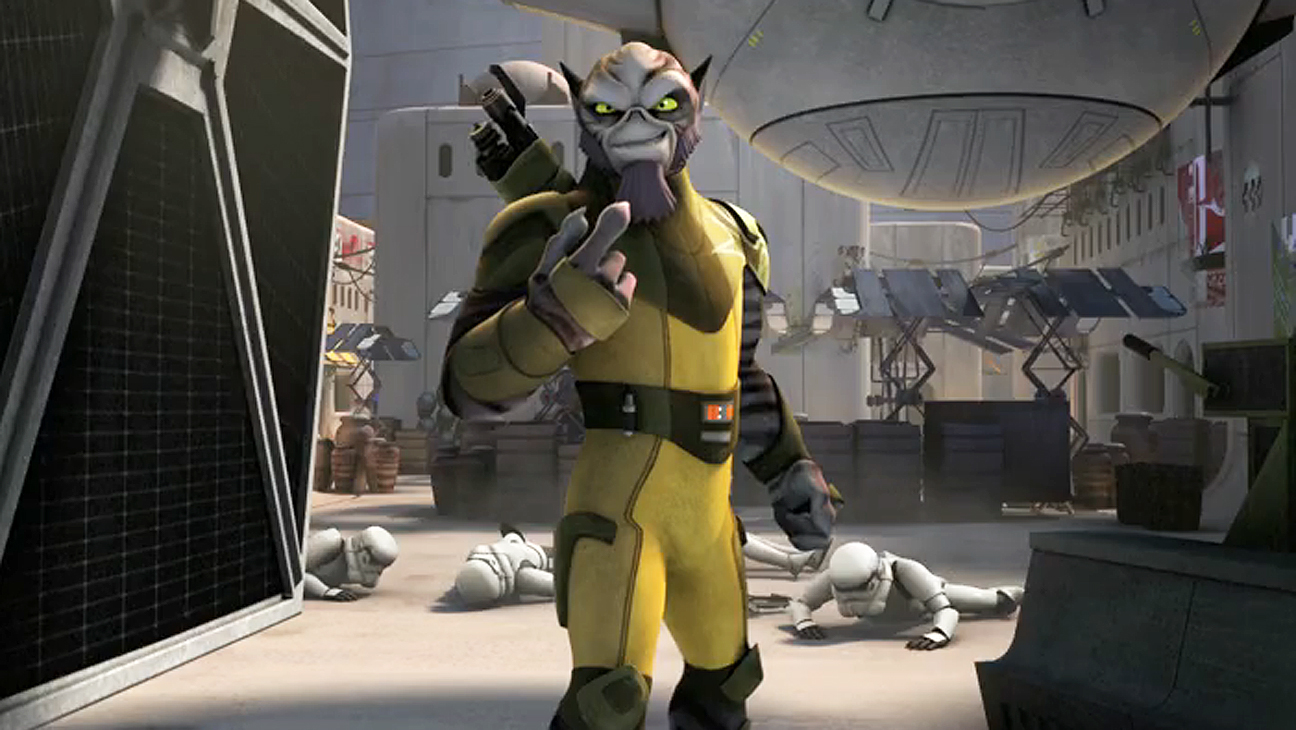
Zeb Orrelios
The droid Chopper also owes a lot to McQuarrie. Chopper'south arms were used on an early concept of R2-D2, the same group promotional shot that features the more Zeb-like Chewbacca. While they were deemed unsuitable for the look of R2-D2, Chopper uses them to gesture in the aforementioned manner a human would, a fitting addition to a drawing character who needs to exist easily interpreted. (And is sort of rude.)
Because McQuarrie's design was so central to the visual manner of A New Promise , the Darth Vader seen in concept art is nearly identical to the costume used in the films. However, comparing Darth Vader in A New Hope to Vader'due south first appearance in Rebels, we tin can see that his mask is slightly more angular than in other Star Wars films, the grill over his mouth slightly distorted to requite information technology a more than elastic shape that fits both blitheness and the energetic manner of McQuarrie's art. The later on cinematic Vader's pattern is more rigid, the sides of the helmet less flared than the concept fine art.
Rebels too uses "this distinctive fashion that [McQuarrie] would pigment the moons and the planets in the sky," Filoni told The Huffington Post. McQuarrie's skies include vivid colors, carefully called gradients, and splashes of color even in the vacuum of space.
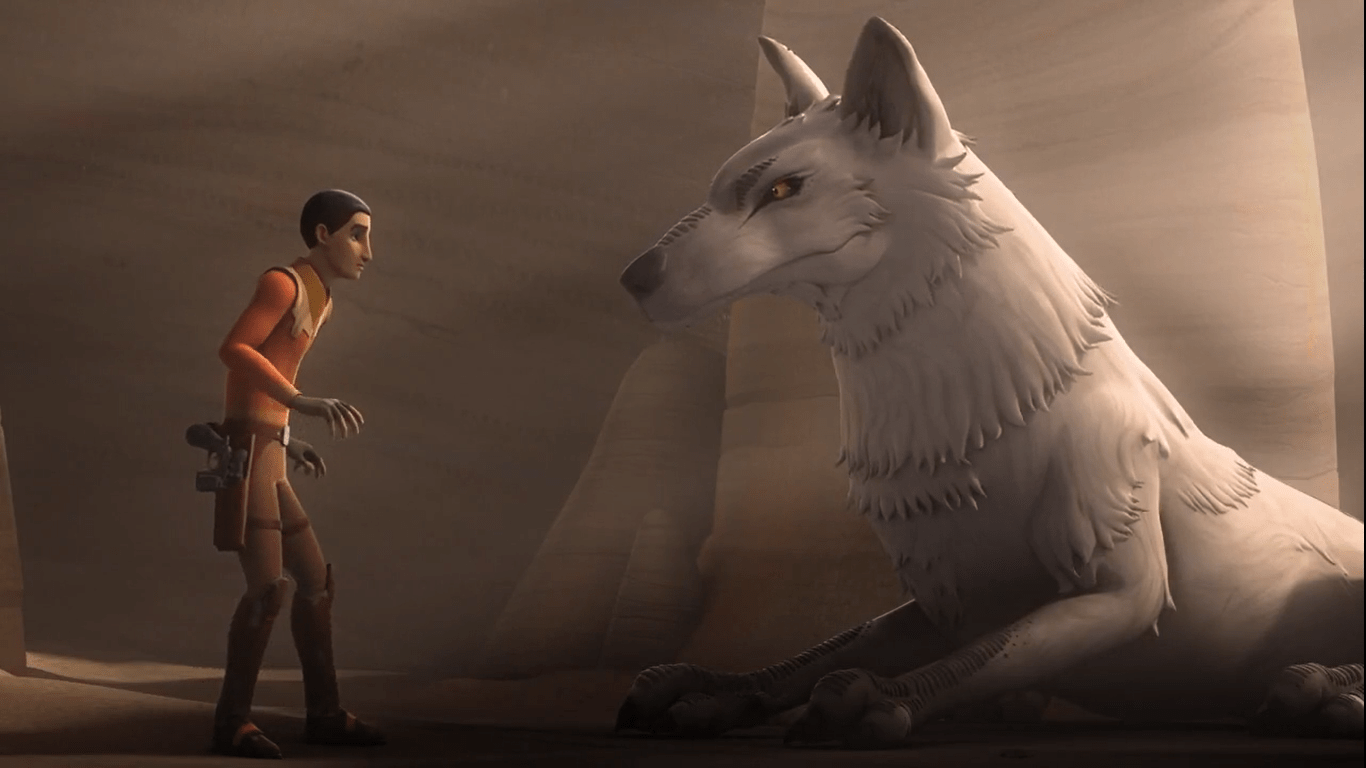
Ezra and the Loth-wolf
In season four, ane of the repeated visuals is the loth-wolf. A Filoni-esque creation through and through, the predecessor of the loth-wolf can be seen in doodles of Ahsoka with a wolf and in Captain Wolffe's clone trooper blazes. There are some similarities to McQuarrie's animate being designs, though: annotation the rounded silhouette of the wolf's shoulders and the way it is oftentimes contrasted with a starry sky. The animate being is fierce, but the rounded elements give it a softness that recalls the whimsical appearance of the Wookiees and banthas McQuarrie created.
Filoni'due south own drawings have become a big function of Rebels ' visual language, besides as many designs created for the Prequel Trilogy and The Clone Wars , such as the anile Darth Maul or the Mortis-similar mystique of the Bendu. Rebels continues edifice off George Lucas' vision for a vibrant, lived-in science fiction universe, which ways that things always go back to McQuarrie, the brilliant pioneer who traveled to the galaxy far, far away before we always even got to visit it on the big screen.
hardwickprehopecon.blogspot.com
Source: https://www.denofgeek.com/tv/how-ralph-mcquarries-art-inspired-star-wars-rebels/
0 Response to "Ralph Mcquarrie Original Star Wars Concept Art in Motion"
Postar um comentário